


Advertisements
Have you invested in the Asian market and are now looking to understand how small business loans India work with the goal of expanding your operation? Understanding how credit works in a country of continental dimensions requires heightened attention to detail.
Mastery over small business loans India is a decisive differentiator aimed at the sustainable growth of any enterprise. Many are unaware of the recent changes in classification limits and government guarantees. This makes it difficult to control costs and choose the most advantageous credit line among the various options available.
Today we help you understand these and other vital details about small business loans India. Continue reading to discover all the financing options and interest rates.
Get to Know the Small Business Loans India
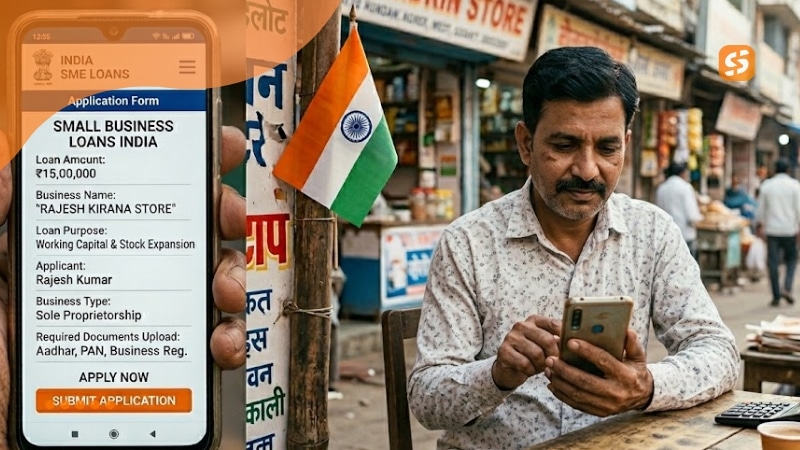
The diversity of credit schemes in India serves everyone from the street vendor to the high-tech industry. We analyze the most interesting options on the market, now. Keep reading.
1. Pradhan Mantri Mudra Yojana
The Mudra scheme offers loans for micro-entrepreneurs in India, without the need for physical collateral, which is ideal for financial inclusion.
You should know that the program, called Pradhan Mantri Mudra Yojana (PMMY), divides the offers into categories.
Additionally, the new feature is Tarun Plus, which allows financing of up to ₹ 20 Lakhs for entrepreneurs with a positive history in the program. This is ideal for initial capital for small points of sale and service providers.
It is worth noting that annual interest rates vary between 8.50% and 12%, depending on the applicant’s risk profile.
Furthermore, a great benefit for the initial categories is the exemption from processing fees. Making the financial resource more accessible.
2. Credit Guarantee Fund Trust (Small Business Loans India)
CGTMSE is an essential Indian loan program for small businesses without collateral.
Firstly, it is important to highlight that the government acts as a guarantor, covering up to 85% of the risk (in addition, the benefit is greater for women/remote areas).
Another relevant point is that the guarantee limit expanded to ₹ 10 Crores (2025) for large manufacturing projects.
Therefore, in terms of cost, the Annual Guarantee Fee (starting at 0.37%) is relatively low and is compensated by the high value of credit without real collateral. This is crucial for industrial modernization and competitiveness.
3. Prime Minister’s Employment Generation Programme
This program aims, first and foremost, to promote self-employment through the development of new projects.
One of the main attractions of this small business financing modality in India is the capital subsidy, known as Margin Money, which can cover up to 35% of the total project value.
Furthermore, units located in rural areas receive an even greater incentive. This focus therefore aims at the decentralization of economic development and the promotion of local industry outside major urban centers.
Regarding the limits, financing limits are ₹ 50 Lakhs for manufacturing projects and ₹ 20 Lakhs for services.
It is worth noting that the repayment period varies between 3 and 7 years, and is preceded by a quite flexible initial grace period.
In short, this scheme is ideal for those who are establishing a new productive unit and seeking to reduce the principal amount of the debt through direct support from the Ministry of MSMEs.
4. Stand-Up India
The Stand-Up India program was created to boost entrepreneurship. With a special focus on women and specific communities.
Furthermore, the program imposes a unique requirement: each bank branch must finance at least one project that fits this profile.
The loans, which fall under the category of financing for small businesses (MSME loans India), range from ₹ 10 Lakhs to ₹ 2 Crores.
In addition, the emphasis is entirely on “Greenfield” projects, i.e., innovative and completely new ventures in the Indian market.
The financing conditions are favorable:
- Interest Rate: Equivalent to the bank’s minimum rate (MCLR) plus 3%.
- Repayment Period: Up to 7 years.
- Grace Period (Moratorium): Possibility of up to 18 months, which means a crucial period for business maturation, where the focus is exclusively on the development of the venture.
Finally, the program complements the capital with mentoring and training services, thus ensuring that the application of resources is efficient and strategic.
5. PSB (Small Business Loans India)
This digital platform stands out for its agility, providing “in principle” approvals in less than an hour.
As a rule, the system uses the integration of billing data (GST) and income tax returns to automate the risk analysis of various small business loans in India. Its main features are:
- Values: From ₹ 1 Lakh to ₹ 5 Crores, ideal for working capital emergencies and short-term expansion;
- Process: Completely remote, allowing the entrepreneur to select the best proposal among more than 21 partner banks;
- Costs and Disbursement: Low digital convenience fee and effective disbursement within a few business days after final document verification.
Thus, this is the ideal solution for those seeking extreme speed in raising capital and having a transparent accounting situation.
6. SIDBI SMILE
SIDBI SMILE is financing focused on the manufacturing sector, aligned with the national campaign.
Firstly, it offers favorable credit conditions (“quasi-capital”) to maintain the financial health of growing companies. Helping to balance debt/equity ratios.
The conditions offered are as follows:
- Objective: Equipment acquisition, with a focus on cutting-edge technology.
- Minimum Value: ₹ 10 Lakhs.
- Repayment Period: Up to 10 years.
- Grace Period: One of the longest on the market. For example, it can reach up to 36 months.
- Interest Rates: Vary between 9.25% and 10.50%. Depending on the assessed risk profile.
In summary, this modality is crucial for industrial projects that require a long implementation period until they reach the financial break-even point.
7. Credit Linked Capital Subsidy Scheme (Small Business Loans India)
The Credit Linked Capital Subsidy Scheme (CLCSS) is, therefore, a fundamental program for companies seeking technological modernization.
Indeed, it offers a 15% subsidy on the loan amount used to acquire modern machinery in key sectors such as textiles, electronics, and agro-industry. Thus reducing the cost of small business loans in India.
The maximum subsidy benefit is ₹ 15 Lakhs (for financing up to ₹ 1 Crore). Although financing occurs at commercial banks’ market rates, the capital subsidy makes modernization much more accessible for the small industrial entrepreneur.
Furthermore, participation in the CLCSS requires that the technology to be purchased is on the government’s approved list, thus ensuring the elevation of the national production quality standard.
8. Micro Enterprises Credit Card
The ME-Card is a corporate credit card for micro-enterprises, launched in the last budget.
It offers agile financing for small businesses in India (small business loans India) with immediate liquidity and limits of up to ₹ 5 Lakhs, based on digital billing.
It is worth noting that its objective is to facilitate the management of daily cash flow, allowing quick payment of suppliers and bills.
The card operates with revolving credit, applying interest only on the amount used, eliminating the bureaucracy of recurring working capital requests.
This innovation benefits from the mass digitalization of the Indian payment system to provide a direct and practical benefit to the small entrepreneur.
Comparative Table of Small Business Loans India
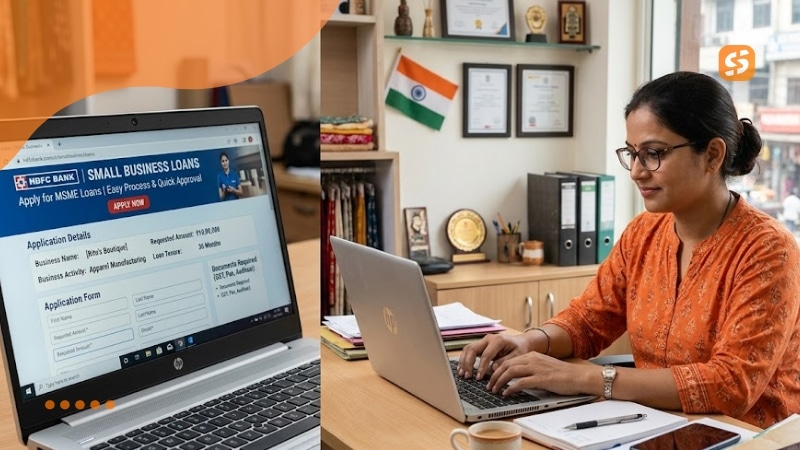
Below, we consolidate the main data to facilitate direct comparison between the different modalities of small business loans India available in Indian territory.
| Scheme / Bank | Credit Limit | Interest Rate (Est. p.a.) | Collateral Requirement |
| Mudra (Tarun Plus) | Up to ₹ 20 Lakhs | 9% to 12% | Exempt |
| CGTMSE | Up to ₹ 10 Crores | MCLR + Spread | State Guarantee |
| PMEGP | Up to ₹ 50 Lakhs | Market Rate | Subsidy of up to 35% |
| Stand-Up India | Up to ₹ 2 Crores | MCLR + 3% | CGFSI Guarantee |
| PSB 59 Minutes | Up to ₹ 5 Crores | Starting at 8.50% | Variable |
| SIDBI SMILE | Up to ₹ 3 Crores | 9.25% to 10.50% | Project Assets |
| SBI SSBL | Up to ₹ 50 Lakhs | 10% to 11.60% | Nil to Partial |
| ICICI BIL | Up to ₹ 50 Lakhs | 13.25% to 19.25% | Exempt |
Conclusion
Financing for small businesses in India has been digitized, eliminating historical barriers and boosting the growth of MSMEs. Supported by state subsidies and guarantees (2025-2026). Approval requires impeccable accounting management and a strong digital presence.
Furthermore, the choice between Mudra loans or CGTMSE lines must align with the long-term strategic planning. India aims to be a manufacturing powerhouse, and credit is vital. Maintaining formalization and following RBI standards ensures access to the best conditions.
The next step is action: carry out the Udyam Registration and use digital platforms to obtain capital proposals. The economic environment is favorable for expansion; do not delay growth due to lack of resources.
Want to start with smaller amounts? Then, you should know about personal loans bad credit India. This way, you will have a good amount to invest in your business.