



Advertisements
For those looking to successfully complete a credit card apply ireland, understanding the current financial landscape of the Emerald Isle is the first step to success. The market has undergone drastic changes that require extra attention when choosing the right product for your consumption and income profile.
The decision to complete a credit card apply ireland involves more than just comparing interest rates, as factors like government Stamp Duty and the Central Credit Register directly influence the final cost and your long-term financial health.
In this complete guide, we will explain everything you need to know to ensure your credit card apply ireland is approved without complications. By the end of this reading, you will have total clarity on which card fits your goals and how to avoid the most common mistakes made by new residents and students in the Irish banking system.
Discover the perfect card for your financial reality
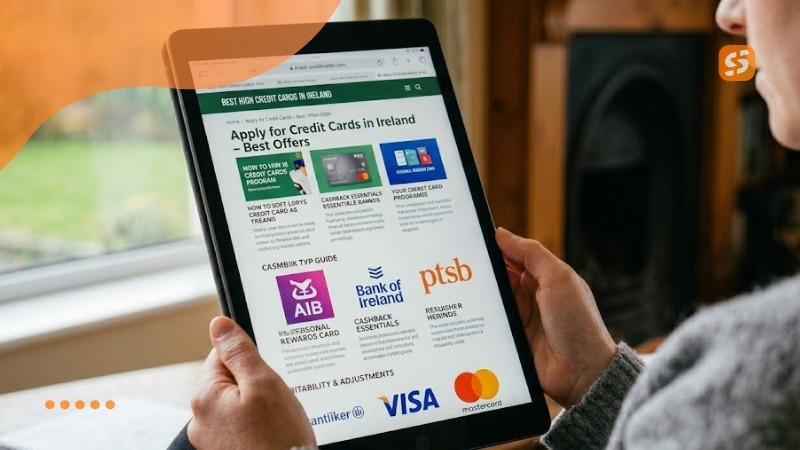
Credit in Ireland is segmented by risk profile. The unique financial sector is marked by the Stamp Duty (a fixed annual tax), leading banks to offer benefits to compensate for it.
Institutions use variable interest rates, expressed by the APR or TAEG (Total Annual Effective Charge Rate).
This indicator is crucial for comparing the real cost, as it consolidates interest, fees, and taxes.
1. Standard Cards
Credit cards considered “basic” serve as the first step for most consumers who wish to build a credit history.
Notable examples in the market include the Classic Credit Card from Bank of Ireland and the CLICK Visa from AIB. These cards are designed with a focus on simplicity and ease of everyday use.
The main advantage is the exemption from maintenance fees charged by the banking institution. The only fixed cost is the mandatory government charge of 30 €.
These cards are ideal for those seeking practicality and savings, as they offer an interest-free credit period of up to 56 days. This applies provided the total bill amount is paid in full by the due date.
2. Cashback Focused Cards
With growing competition, credit cards with cashback (financial return) are becoming increasingly popular. In this segment, the Everyday+ from Avant Money and the AIB Platinum Visa stand out.
The Everyday+ from Avant Money adopts an aggressive approach, offering a 5% return on grocery and fuel expenses during the first year. This is a significant advantage to help offset the rising cost of living.
On the other hand, the AIB Platinum requires a higher minimum annual income, about 40,000 €. This makes it ideal for those who have an annual spending volume exceeding 5,000 €.
This card focuses on rewards and is frequently the choice of established professionals.
2. Miles Cards (Credit Card Apply Ireland)
In Ireland, due to its island nature and the importance of Aer Lingus, credit cards for travelers are highly sought after. In fact, this card category is the best credit card Ireland for travel.
Firstly, the Aer Credit Card from the Bank of Ireland is a notable example, allowing the holder to accumulate Avios on every purchase, which can be used to obtain flights or class upgrades.
In addition to mileage accumulation, this card offers comprehensive travel insurance for multiple trips and free access to VIP lounges at Dublin, Cork, and Shannon airports.
However, it is important to consider the monthly maintenance fee of 6.50 €, weighing it against the holder’s travel frequency to ensure the benefit outweighs the cost.
3. Balance Transfer Cards
Credit cards with Balance Transfer are crucial instruments for managing high-interest debt.
They enable the transfer of the outstanding balance to a new account that offers a promotional 0% interest rate, usually valid for 6 to 12 months.
Notable examples in the market include the An Post Money Classic and the PTSB ICE Visa. This strategy allows the consumer to stop the accumulation of interest, focusing entirely on paying off the principal amount.
It is, therefore, an intelligent financial approach to reorganize accounts and generate significant savings during the interest-free period.
Protect your wallet from Stamp Duty and credit history
The Irish Government charges a fixed annual tax of 30 €, known as Stamp Duty, on every active credit card account.
- Charge: Banks debit this amount in January to pass it on to the State.
- Cancellation: Canceling the account at any time of the year requires immediate payment of the full tax amount.
- Additional Cards: Extra cards for dependents linked to the same ownership are not subject to new taxation.
The Central Credit Register (CCR) is the Irish system that monitors credit operations exceeding 500 €.
Unlike other systems, the CCR does not use numerical scores. It focuses on a detailed report of the payment history over the last five years.
A record with delays is a limiting factor, especially for those seeking a mortgage. This is because banks are required to consult this factual data to assess the risk of customers residing in Ireland.
Understand now how to complete your credit card apply ireland
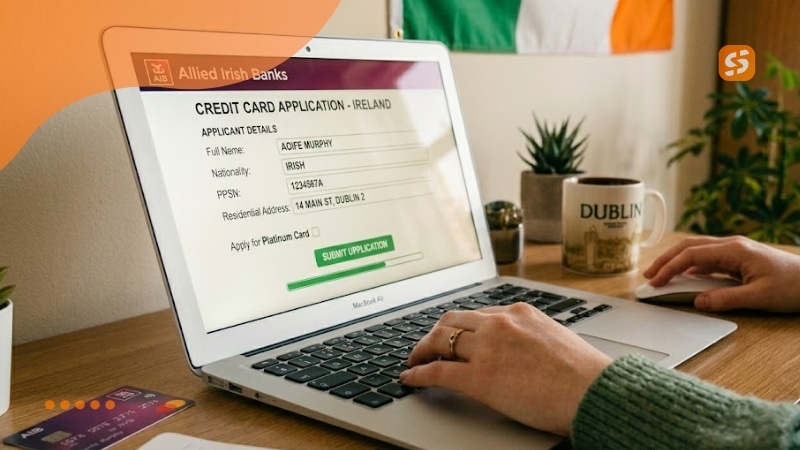
Digitalization has significantly simplified the credit card apply ireland process, enabling most steps to be completed online.
To ensure smooth approval, it is essential to follow a logical sequence of data preparation and submission.
This way, it is possible to avoid common errors that would result in the automatic rejection of your application.
1. Know your eligibility before you start (Credit Card Apply Ireland)
Before applying for a credit card, it is crucial to analyze your financial situation. Most financial institutions in Ireland require applicants to be at least 18 years old and have official residency in the Republic of Ireland.
Furthermore, the minimum annual income generally starts at €16,000 for basic cards.
To evaluate your chances of approval without harming your credit history in the Central Credit Register, use eligibility verification tools (such as those offered by Avant Money).
These tools perform soft checks, providing a clear indication of your eligibility.
2. Have all documentation ready for submission
To meet customer identification requirements, clear digital copies of key documents are necessary.
These include a valid passport or an EU driving license, along with recent proof of residence.
Documents accepted for proof of residence (issued within the last 3 to 6 months):
- Utility bills (electricity, gas).
- Bank statements.
It is imperative that your name and address appear identically on all documents. Any inconsistency, even minimal, can block the bank’s automatic verification process.
3. Use the PPSN as your ally in approval (Credit Card Apply Ireland)
The Personal Public Service Number (PPSN) is a non-negotiable legal requirement for any credit application in Ireland.
You can prove your PPSN by presenting official documents that clearly display the printed number, such as:
- Pay slips;
- Revenue (Tax Authority) documents;
- Letters from the Department of Social Protection.
Banks only accept documents with your printed PPSN for verification; the physical Public Services Card (PSC) does not qualify as valid proof.
4. Use Open Banking technology to your advantage (Credit Card Apply Ireland)
A major technological innovation in the sector is Open Banking. You can accelerate your application by authorizing the bank to sync your financial statements instantly for rapid income and spending validation.
If you prefer the traditional method, you will need to manually upload PDF files of your last three months’ statements from your main current account.
It is essential to ensure that the bank logo and all account details are fully visible in the uploaded files.
5. Ensure your security with digital biometrics
Modern and digital banks, such as Revolut and Bank of Ireland, adopt a biometric verification process in their applications.
For security against fraud and identity theft, the system requires the applicant to take a real-time photo of their face.
The system then compares your biometric image with the photo on your identity document to verify a perfect match.
Thanks to the use of artificial intelligence, it is possible to confirm that the person making the application is, in fact, the holder of the documents, significantly speeding up the final approval process.
6. Discover how the CCR influences your real score
After submitting your data, the bank will make a formal consultation with the Central Credit Register.
The analysis process will involve checking your current level of indebtedness and the history of how you managed previous loans.
If you already have other credit cards, the analyst will evaluate whether the new limit requested is compatible with your monthly repayment capacity.
The decision may be an instant approval, generated by the system.
A human risk underwriter conducts a manual review for more complex profiles to ensure a fair and accurate credit assessment.
7. Receive your card and perform the correct activation
Upon credit approval, the contract is sent digitally for electronic signature.
The bank sends your physical card by post, delivering it to your verified address within five to ten business days.
To ensure maximum security, the bank sends your PIN in a separate letter or requires you to access it through the official banking app.
Card activation occurs during the first physical transaction, whether in a store or ATM, using the received PIN. This confirms the safe receipt of the product.
Conclusion
Applying for a credit card apply ireland requires knowledge of tax obligations and credit rules (CCR).
There are several options, from travel rewards to cashback, but it requires financial discipline and strategic use of the zero-interest period. The choice shapes your purchasing power and future in Europe. A positive history in the CCR is crucial for your stability.
Smart consumers view credit as a strategic convenience and a tool to build banking credibility, prioritizing on-time payments to strengthen their financial profile.
With this information and step-by-step guide, arrange your documentation and PPSN and start your application today to enjoy the benefits.