



Advertisements
Understanding the root causes and real impacts of the South Africa water crisis 2026 reveals a severe operational collapse in public supply networks across the country.
Furthermore, investigating the reasons supporting the South Africa water crisis 2026 becomes essential, as the distribution failure harms the economy, the countryside, and the daily lives of millions of people.
This analysis details the hydraulic data and June 2026 updates on the South Africa water crisis 2026, providing a complete overview to understand the technical and political solutions under discussion.
The causes of the collapse in South African water supply

South Africa has been facing a serious water shortage since February 2026, a situation that requires urgent attention.
Decades of little investment, neglect of pipeline maintenance, and vandalism have destroyed the supply system.
The responsible companies fail by not repairing the damage and due to a lack of trained technicians.
Furthermore, official reports confirm the abandonment of distribution networks in cities and poor regions.
Therefore, immediate measures are essential to prevent a total water blackout in the country.
The collapse that threatens the health of the provinces (South Africa water crisis 2026)
The lack of water affects regions in different ways, increasing the suffering of families. In the Northern Cape, the situation has worsened drastically, as 87% of water networks are currently malfunctioning.
Consequently, the Free State faces a collapse in 59% of systems, increasing the danger of serious diseases in rural areas.
Moreover, in the Northwest, constant interruptions impede work in the countryside. In Gauteng, the system is operating at its limit and leaves 109 regions without financial security and without regular access to water.
| Province or Region | Networks in Critical Status | Fraction of Unsafe or Risky Water | Volume of Projects and Alerts |
| Northern Cape | Jump from 48% to 87% | 13% of supply considered unsafe | 277 systems under severe surveillance |
| Free State | Increase from 31% to 59% | Risk of biological contamination in wells | 51 suggested emergency projects |
| Northwest | Prolonged interruptions | Severe damage to agricultural basins | R9 billion projects in Madibeng |
| Gauteng | Unstable margins | Long-lasting urban leaks | 109 authorities under financial crisis |
Crucial points you should know about the current water crisis
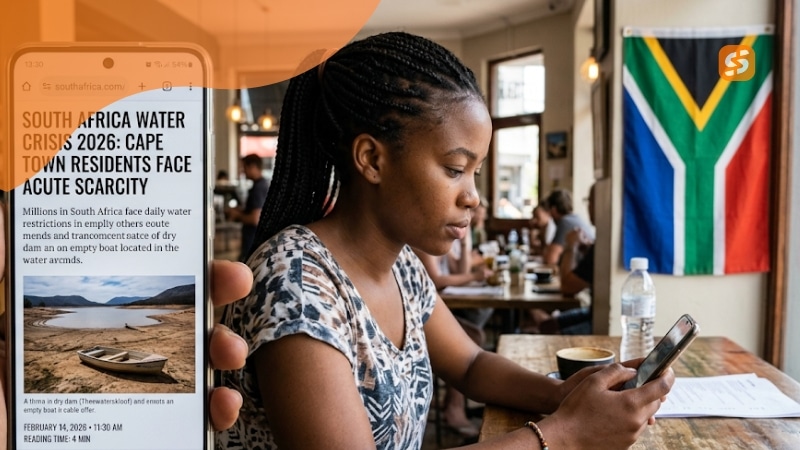
The scenario involving South African water resources on June 5, 2026, is marked by an overlap of labor strikes, post-maintenance reconfigurations in metropolitan networks, climate-related judicial disputes, and new technological pressures on water sources, detailed as follows.
1. Strong hidden impact of artificial intelligence on water (South Africa water crisis 2026)
Artificial intelligence consumes water at alarming levels. A recent UN study reveals the hidden cost of modern technology.
In this sense, giant data centers will need 9.3 trillion liters of water by 2030 to cool their equipment.
This absurd volume would be enough to supply 1.3 billion people in Sub-Saharan Africa.
Furthermore, technological advancement accelerates the consumption of essential natural resources. As a result, poorer nations suffer from scarcity. While the sector’s profits do not reach those who need it most.
Strikes and contamination worsen the scenario in KwaZulu-Natal
In KwaZulu-Natal, the municipal workers’ strike completes three days in Pietermaritzburg, halting essential services.
Demonstrators set up barriers at deposits and prevent the repair of broken pipes in the streets.
Furthermore, the water company confirmed that a type of algae caused the bad taste in the water in Durban after the intense heat.
Despite the earthy smell, the company guarantees that the product is not harmful to health.
Finally, technicians state that the liquid remains safe for family consumption.
The judicial and climate battle for the future of water (South Africa water crisis 2026)
Human rights organizations are suing the African justice system for action against climate neglect, which violates the basic right to access water.
You should know that environmental teams have begun removing invasive plants in the Western Cape.
This measure helps in the recovery of rivers, as it removes vegetation that consumes excessive water and harms local plants. Therefore, the strategy seeks to ensure the balance of hydrographic basins.
Gauteng suffers from failures in the return of supply
Repairs at Rand Water stations interrupt supply in Johannesburg. Distribution fails in high-lying neighborhoods, such as Brixton and Sophiatown.
As a result, the lack of pressure in the pipes forces families to depend on water tankers.
Given this scenario, the delay in service leaves thousands of people without water in their taps every day.
Floods and leaks expose water fragility (South Africa water crisis 2026)
On the other hand, strong storms in the Eastern Cape caused floods.
The disaster displaced 700 residents of Nelson Mandela Bay, now housed in the Lithembaletu Community Hall.
Meanwhile, in the Garden Route, dams are operating at maximum capacity and triggering flood alerts.
Concurrently, in Midrand, a leak wasted potable water for 14 consecutive days in Wards 110 and 132. The incident drained hydrants and generated local outrage due to Johannesburg Water’s delay in repairing the network.
The political impasse and technical damage in Lesedi
Politician Stephen Moore criticized the government for postponing the delivery of the urgent water plan. This delay is worrying, after all, more than a hundred cities are currently suffering from red accounts and broken networks.
Concurrently, the return of water in Lesedi damaged old pipelines. The accumulated air pressure in the empty pipes ruptured metallic joints and consequently caused new damage to the local infrastructure.
Learn more about the water crisis in South Africa
Why did the government declare a water emergency in 2026?
The government formalized the crisis in February 2026 after serious failures in the Zuikerbosch and Palmiet pumps. The situation became unsustainable because half of the treated water is lost due to leaks.
Furthermore, in the Northern Cape, almost all distribution networks are in terrible condition. Therefore, the State recognized that the current management model has failed.
How does Rand Water maintenance impact daily life in Gauteng?
Repair shutdowns reveal the fragility of the pipelines. When the pumps stop, the networks empty completely.
Consequently, the return of water takes days, as the accumulated air in the pipes causes excessive pressure.
This process breaks old connections and prevents constant access to the resource.
How do climate and drought affect water supply?
The El Niño climate event, expected at the end of 2026, will drastically reduce rainfall. Thus, important dams will lose volume.
As a result, cities and industries will face severe usage restrictions, further exacerbating the difficulty of supply in already vulnerable areas.
Why do artificial intelligence data centers threaten water?
Artificial intelligence requires enormous volumes of water to cool servers. Studies indicate that the consumption of these machines by 2030 will be immense.
Therefore, there will be a dispute over scarce resources, removing water that should supply families, especially in regions with water stress.
What investments did the government propose to solve the crisis?
The government created a Crisis Committee and promised R185.2 billion for new works and dams. Furthermore, it seeks to attract private investment to the sector.
However, experts criticize the slowness in applying these resources and the lack of transparency in the proposed actions to fix the network.
Conclusion
In summary, the collapse of the water supply reflects serious governance failures and water infrastructure, highlighting massive physical losses in national distribution.
This situation requires deep structural reforms aimed at overcoming administrative inefficiency and protecting communities against the advance of cartéis and inequalities.
Follow updates on the country’s water policies and demand transparency from authorities in order to guarantee the water security of future generations.
In addition to the water crisis, a worrying point is the job crisis in South Africa. To ensure you are up to date with all the news, see the South Africa economic crisis news now.