



Advertisements
Planning your academic future requires you to know the best student loan options South Africa available.
The cost of higher education, whether at universities or technical institutions, is high. Furthermore, family savings or partial scholarships are often not enough to cover all expenses.
When analyzing the various student loan options South Africa, one realizes that banks, government, and private financial institutions offer different solutions for each type of student.
In this article, we will look at the main student loan options South Africa. You will find information on government programs for the middle class, offers from major commercial banks, and alternatives for studies abroad.
What is a Student Loan?
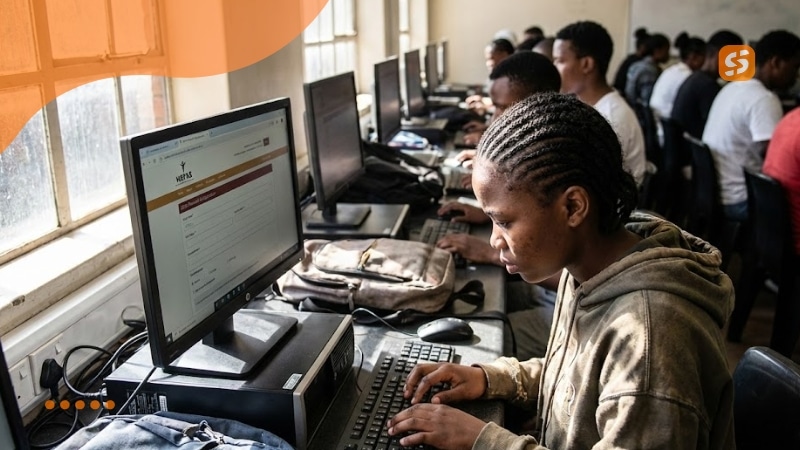
A student loan works as a form of credit where a financial institution, be it a bank, a private company, or a government program, provides the necessary resources to pay for your education.
You need to know that the central concept is that the student receives the capital now to invest in their education, and commits to repaying this amount, plus interest, within defined deadlines after the course completion.
The payment structure generally differs from conventional personal loans.
In many cases, the student may only be responsible for paying the interest while studying, leaving the amortization of the principal capital until after graduation. This facilitates cash flow during the years of study, when the student’s income tends to be lower or nonexistent.
08 Best Student Loan Options South Africa
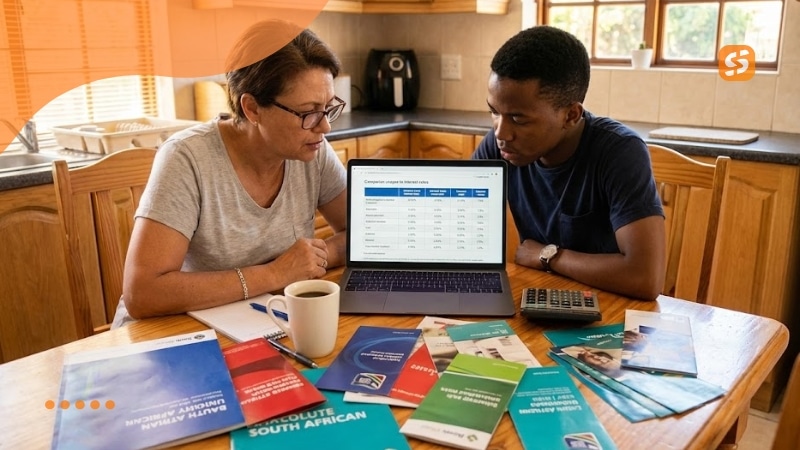
1. NSFAS – Missing Middl Loan (Student loan options South Africa)
The government program NSFAS (National Student Financial Aid Scheme) offers a vital solution for the group known as the “Missing Middle”.
Firstly, this term refers to students whose gross annual family income is between R350,001 and R600,000.
These families are often considered “too wealthy” to qualify for the full NSFAS subsidy, but do not have sufficient resources to pay university tuition fees without aid.
The loan covers tuition, accommodation, and essential materials.
A distinct feature of this program is the interest and repayment structure. Interest only begins to accrue 12 months after the course ends, offering a significant breathing period.
Furthermore, there is an incentive for academic performance: part of the loan can be converted into a bursary (up to 50%) if the student achieves a grade point average equal to or greater than 70%.
The repayment conditions are favourable, with a maximum repayment period of 60 months after the start of employment. Therefore, the interest during studies is free of charge.
2. Capitec Education Loan
Capitec offers a commercial loan with a high value ceiling, reaching up to R500,000.
As a general rule, this line of credit is versatile, serving needs from basic and secondary education to university or technical courses.
Moreover, the institution makes the payment directly to the educational entity, which ensures that the funds are used for the correct purpose.
For extra expenses, the bank offers a revolving facility, allowing the student to use the credit as needed.
Additionally, the repayment term is extended, potentially reaching 84 months (7 years). The interest rates are reduced and fixed, negotiated at the time of contract.
3. Nedbank Education Loan (Student loan options South Africa)
Nedbank is one of the best banks for loans in South Africa, presenting a comprehensive solution that allows financing courses both locally and abroad.
Firstly, the coverage is broad, including tuition, accommodation, transport, and materials, with values ranging from R2,000 up to R400,000.
Furthermore, the repayment period is between 6 and 72 months.
Therefore, it is important to note that this option requires the presence of a guarantor, and the bank makes the payment directly to the educational institution.
The payment structure varies according to the study regime.
Full-time students pay only the interest during the course, starting to amortize the principal value only after the conclusion of their studies.
Part-time students, however, must pay both the capital and interest from the beginning of the contract.
4. Standard Bank – Loan without Surety
Standard Bank innovates by offering a credit line that dispenses with the need for a guarantor, aimed specifically at students who are already advanced in their courses (from the 3rd year onwards).
In this case, the focus is on areas with high market demand, such as STEM (Science, Technology, Engineering, and Mathematics), commerce, and health sciences.
You need to keep in mind that this loan covers tuition, books, accommodation, and even previous academic debts. Certainly, this is an important differential for those with outstanding financial issues with the university.
Furthermore, no payment is required during the course; the student only starts paying after graduation.
The granted value varies according to family income, requiring the gross income to be less than R600,000 per year.
5. Standard Bank – Loan with Surety (Full-Time)
For students who do not meet the criteria for the no-surety option, Standard Bank offers the traditional modality with a guarantor.
This option is flexible, allowing for local or international studies, including specific courses such as a private pilot license.
One benefit is that there is no maximum limit imposed on the tuition value, adapting to high-cost courses.
In this model, the guarantor must prove a minimum income of R3,000 per month and is responsible for paying the interest and fees while the student is at university.
After graduation, the bank grants a 6-month grace period before the student assumes full payment of the debt.
6. Standard Bank – Loan for Part-Time Students
Designed for those who work and study simultaneously, this modality covers all educational expenses. The value is adjusted according to the applicant’s payment capacity, without a predefined limit for registration.
The basic requirement is to have a minimum monthly income of R5,000. Unlike the full-time options, here the student must pay the loan installments (capital and interest) while studying.
Bank also allows for the optional contracting of life or disability protection insurance, offering an extra layer of financial security.
7. FNB Student Loan (Student loan options South Africa)
FNB offers loans that finance tuition, accommodation, equipment, and other necessary materials.
As a general rule, the values range between R1,000 and R360,000.
This alternative stands out for offering the inclusion of a protection plan for both the debtor and the student, in addition to not charging penalties if the client decides to settle the debt early.
During the first 12 months, payment is restricted to interest and fees.
After this period, the installments begin to include capital amortization. The interest rates are linked to the prime rate, with the possibility of obtaining a discount of up to 0.5 percentage points.
8. Absa Study Loan
Absa offers a loan with an interest rate based on the prime rate.
Firstly, the credit can be used to cover registration, tuition, accommodation, and the purchase of a computer, with a maximum value of R250,000.
Furthermore, this line is open to both full-time and part-time students.
For full-time students, the presentation of a parent or sponsor as the main applicant is mandatory.
On the other hand, part-time students must have their own employment to prove payment capacity.
Comparative Table
| Institution | Main Benefit | Maximum Value (Approx.) | Repayment Period |
| NSFAS “Missing Middle” | Conversion of up to 50% into a bursary | Government budget | Max 60 months post-employment |
| Capitec | Revolving access for extras | Up to R500,000 | Up to 84 months |
| Nedbank | Interest only during study (Full-Time) | Up to R400,000 | 6 to 72 months |
| Standard Bank (No Surety) | No guarantor (3rd year+) | Income < R600k/year | Post-graduation |
| FNB | No penalty for early settlement | Up to R360,000 | Follows salary frequency |
| Absa | Interest only in the first 12 months | Up to R250,000 | Flexible |
Conclusion
The student loan options South Africa present a range of ways to finance higher education.
From government programs that convert debt into a bursary for performance to banks that offer a total grace period during studies, there is a suitable solution for every socioeconomic profile.
Know that investing in education through a loan is a decision that anticipates access to better career opportunities.
Although taking on debt requires responsibility and planning, the facilitated conditions of these credit lines, when well managed, serve as a leverage for professional and personal development.
Carefully analyze the options listed in the comparative table and visit the institutions’ websites to simulate the values.
Don’t let the financial barrier impede your growth. Select the alternative that best suits your reality and take the next step in your academic journey today.