


Advertisements
Applying for a Bank of Ireland credit card requires special care in planning the household budget. The Central Bank sets very strict interest rules, ensuring full protection for low-income workers.
Evaluating each Bank of Ireland credit card avoids surprise charges such as the mandatory government tax. Discovering modalities that are completely exempt from annual fees reduces daily fixed costs and protects the daily salary of the entire family.
This article details the Bank of Ireland credit card with clear data on approval, interest, and real limits. Reading it in full ensures a safe choice with the goal of saving money in Ireland.
Compare the main Bank of Ireland cards
| Credit Card | Purchase Rate (Variable) | Typical APR | Minimum Limit | Minimum Income | Recommended Channel |
| Aer Credit Card | 14.00% | 22.70% | €1,600 | €16,000 annual | Digital via Web / App |
| Classic Credit Card | 16.12% | 22.10% | €1,000 | €16,000 annual | Digital via Web / App |
| Platinum Credit Card | 13.79% | 19.60% | €2,500 | €40,000 annual | Digital via Web / App |
| Affinity Credit Card | 14.57% | 20.20% | €1,000 | €16,000 annual | Digital with proof |
| Student Credit Card | 14.54% | 20.20% | €600 | Minimum exempt | Digital via Web / App |
Discover the best credit options on the market
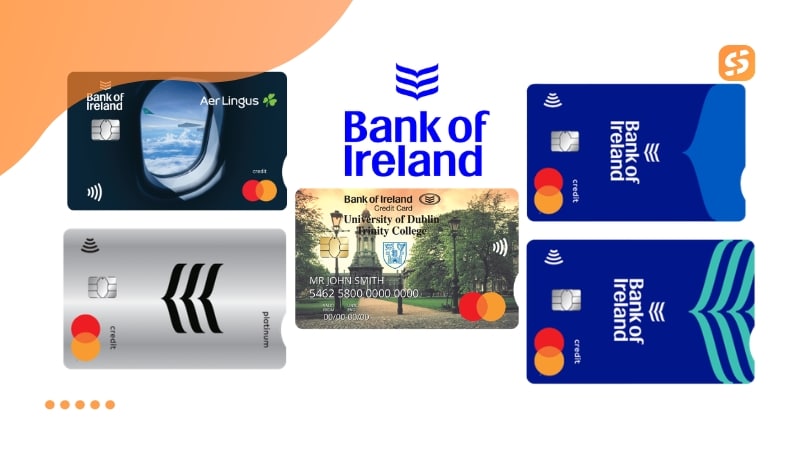
1. Aer Credit Card
The Aer Credit Card offers a financial structure with fixed costs and competitive interest rates in the market.
Firstly, maintenance costs €6.50 per month, which totals €78.00 per year, and requires an annual income of €16,000.00 for a credit limit of at least €1,600.00.
On this card, interest on purchases is 14%, with an APR of 22.70% per year. The interest-free payment period reaches up to 56 days if the bill is paid in full by the due date.
Thus, the 12-month cycle helps to meet the loyalty program’s spending targets.
In addition, this card guarantees benefits for those traveling by plane. The main advantage includes 2 return flights across Europe with Aer Lingus when spending €5,000.00 in the year. However, the package also offers access to VIP lounges, priority security, and travel insurance.
On the other hand, there is a monthly fee even without using the card and the need to pay airport taxes on bonus trips.
2. Classic Credit Card (Bank of Ireland credit card)
The Classic Credit Card eliminates the bank’s annual maintenance charge.
Be aware that joining requires an income of €16,000.00 per year and releases a limit of at least €1,000.00. On purchases, a variable interest of 16.12% is applied, which generates an APR of 22.10% with government taxes.
Also consider that the first 6 months guarantee zero interest on purchases or 7 months without fees for balance transfers. Purchases over €250.00 allow for installment payments with a lower rate of 6.70%.
The great advantage of the classic credit card is the lack of fixed monthly fees. Consequently, the inclusion of up to 3 extra people on the account occurs at no cost.
However, the interest on purchases exceeds the Platinum or Aer models if debt accumulates, without offering points or prizes.
Finally, the service is suitable for families and those who need quick financial relief without paying an annual fee.
3. Platinum Credit Card
The Platinum Credit Card charges €76.18 per year, with an initial limit of €2,500.00. However, access requires proof of an annual income of at least €40,000.00.
Even so, the card has the institution’s lowest interest rates, set at 13.79% variable and an APR of 19.60%.
If the bill is paid in full before the due date, the period reaches up to 56 days interest-free.
In addition, this option guarantees global travel insurance and Mastercard Priceless benefits. However, there is the mandatory annual fee charge.
Another relevant point: the insurance only works if half of the costs of tickets or accommodation are paid with the card.
In this way, it is an alternative aimed at high-income profiles looking for complete protection on trips and a larger volume of credit.
4. Affinity Credit Card
The Affinity Credit Card exempts the account from annual fees, requires an income of €16,000.00 per year, and releases an initial limit of €1,000.00.
Firstly, purchases have interest of 14.57%, which results in an APR of 20.20%.
Furthermore, there is a reduced rate of 2.90% for balance transfers during the first year and a period of up to 56 days for interest-free payment when the bill is paid in full.
As a positive point, using the card supports alumni funds and university scholarships through everyday spending. This, with no extra costs for the customer.
However, the service requires current or past links with institutions such as Trinity College, UCD, UCC, UL, NUI Galway, or Maynooth University.
This option serves students and academic staff well, although it does not offer additional leisure benefits.
5. Student Credit Card (Bank of Ireland credit card)
The student card eliminates annual maintenance fees and discards the requirement for fixed income proof.
On this student credit card, the financial limit accompanies progress in studies. Starting from €600.00 in the first two years and reaching €1,000.00 from the third year of the course.
In terms of costs, the average nominal interest rate is around 14.54% variable, with an APR of 20.20%.
Additionally, a special offer guarantees zero interest on purchases during the first six months. Combined with the period of up to 56 days for full settlement of the bill without charges.
The ease of entry into the credit system without a paycheck and the inclusion of travel insurance for exchanges represent the greatest benefits.
On the other hand, the reduced spending ceiling and the obligation to maintain an active current account for six months with direct debit appear as points of attention.
Consequently, the modality focuses on university students in Ireland interested in starting a positive financial history with safety and control during academic learning.
Request your now with this step-by-step Bank of Ireland credit card
Obtaining a Bank of Ireland credit card depends on following clear steps to validate security requirements and credit analysis.
Initially, choosing the ideal card must respect the rules of a minimum age of 18, tax residence in Ireland, and the annual income limit of each category.
In addition, gathering the mandatory documents speeds up the process. The list includes photo ID, recent proof of address, PPS number, and the last three pay slips with bank statements.
Subsequently, the form is filled out on the bank’s website or application in a few minutes. There is also the option to start the application by phone or at physical branches.
Immediately after sending the data, the digital verification system receives the files. The use of facial biometrics in this phase speeds up confirmation of the applicant’s identity.
Finally, the financial analysis consults the Central Credit Register.
With everything in order, approval is issued within 24 business hours and the delivery of the physical card to the registered address takes about five days.
Conclusion
Choosing a Bank of Ireland credit card requires attention to fees and annual costs.
Options without annual fees protect the family budget and avoid unnecessary charges. Clearing the total monthly bill balance eliminates the accumulation of debt.
Maintaining control of expenses ensures financial stability. Simple credit lines with low income requirements help build a secure history in Ireland without compromising daily earnings.
With the aim of comparing economical choices, we suggest you check out a comparison of An Post credit card Ireland. Knowing new alternatives helps in choosing the best financial option.