



Advertisements
Closely monitoring the South Africa economic news landscape is essential for understanding global finance today. The market is experiencing a moment of strong productive transformation. For this reason, investors monitor the country’s new direction with great attention.
Furthermore, understanding the nuances of South Africa economic news helps protect your own financial wealth. Central bank decisions directly impact the pockets of millions of families. Thus, clear information becomes a valuable decision-making tool.
You will see here how each of the South Africa economic news items reveals unprecedented opportunities in the local corporate sector. Follow the main figures and analyses of the current scenario below. Discover now what is truly moving business in this promising quarter. Keep reading
South African Currency Gained Momentum, Understand the Reason
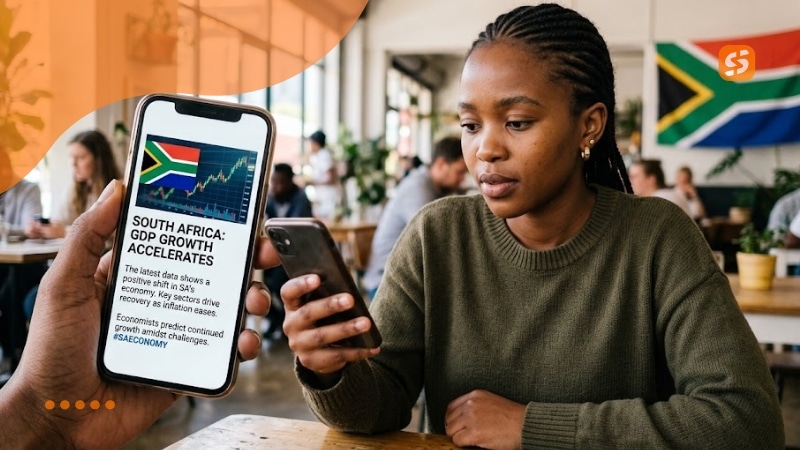
South Africa’s national currency, the Rand, surprised analysts by registering a recent appreciation. Know that the exchange rate reached the mark of R16.04 per dollar at the beginning of daily trading.
This advance occurred, first and foremost, due to employment data from the United States.
The US market generated fewer jobs than expected by specialists. Consequently, the dollar lost strength on the international scene against emerging market currencies.
In addition, the Rand maintained stability against other relevant world currencies. The euro traded in the range of R18.60, while the pound remained close to R21.65.
However, this exchange rate relief does not eliminate all of the country’s short-term challenges. Geopolitical tensions abroad still keep crude oil prices elevated. For this reason, fuel costs continue to demand considerable caution from authorities.
What to Expect from Interest Rates in the Country in the Coming Months?
The South African Reserve Bank opted to maintain the benchmark rate at 7.00%. This strategic decision aims to curb consumer price pressures.
Currently, the consumer inflation rate stood at 4.3% in the latest survey. However, analysts project an acceleration to around 5.0% in upcoming readings.
This estimated increase stems mainly from energy and land transport pass-throughs. Brent crude above US$95 places strong upward pressure on diesel prices. Thus, the central bank prefers not to risk a premature interest rate cut.
With high interest rates, government bonds continue offering a very attractive yield. Rates on 2035 sovereign bonds eased slightly to 8.65% per year. Thus, local debt continues to attract foreign capital seeking profitability.
How Gold and Platinum Boost the Balance and Change the Economy?

The mining sector has once again become the main driver of South African exports.
Recently, international gold reached historic highs, surpassing the level of US$ 4,430 per ounce.
This surge occurs due to the global search for safe-haven assets amidst conflicts. Besides gold, demand for platinum and palladium posted significant numbers.
A striking example was the annual financial results of miner Impala Platinum. The company surged from R761 million to a profit of R31.04 billion. That is an operational growth of more than forty times in one year.
Thanks to this result, the company distributed R17.1 billion in dividends to investors. Consequently, government tax revenues received a very welcome boost. These foreign exchange earnings help firmly support public accounts.
The Challenge of Urban Infrastructure in South Africa (South Africa economic news)
The South African government signed a financial agreement with European development banks. The contribution totals R5.6 billion granted by the German agency KfW and the French AFD.
These resources will be injected directly into the reform program for metropolitan services. The main objective is to revitalize the treated water distribution network and electricity grid.
Eight major metropolitan municipalities will directly benefit from this new structural project. In total, the initiative will impact the routine of more than 22 million people.
However, business sentiment still expresses apprehension regarding public services. The confidence index fell to 38 points, revealing concern over infrastructure. Therefore, the rapid execution of these works will be essential to unlock private investments.
E-Commerce Breaks Historical Records
Online retail in South Africa surpassed 10% of total retail for the first time. Estimates point out that online sales should reach R159 billion this year.
This advance represents an impressive annual growth of over 22%. Meanwhile, traditional brick-and-mortar retail grew a modest 4%.
Major sector brands finally achieved significant profitability in their digital operations. The Takealot platform recorded its first annual profit after fifteen years of history.
At the same time, delivery app Checkers Sixty60 moved R25.5 billion.
On the other hand, traditional chains focused on apparel, such as Woolworths, lost market value.
Therefore, consumer behavior has definitively migrated to apps and smartphones.
The Historic Shift of Discovery Bank
The fintech and digital banking segment celebrated an unprecedented financial milestone. Discovery Bank reported its first annual profit since commencing operations.
Normalized operating profit totaled an impressive R370 million in the last financial year. The active client portfolio advanced to the mark of 1.57 million clients.
Furthermore, deposit volume grew 17%, totaling R27.2 billion. The credit portfolio also expanded with a controlled loss rate.
This turnaround ends a cycle of heavy investments made by the parent company. Therefore, the purely digital model proves its commercial sustainability and attracts investors.
Traditional banks now need to accelerate their modernization so as not to lose ground.
Natural Events and the Financial Impact on Insurers (South Africa economic news)
The financial sector does not depend solely on currencies and bank interest rates. Climate factors have caused direct impacts on the accounts of the country’s largest companies.
Insurance provider Santam, for example, saw a drop in its underwriting margin.
This reduction stemmed from severe flooding and windstorms in the Western Cape and Limpopo. Unseasonable storms generated a high volume of residential and commercial claims.
To deeply understand how recent cold fronts, droughts, and rains affect infrastructure, follow real-time updates on South Africa weather news.
Thus, it is clear that environmental monitoring is vital to mitigating economic risks. Companies must plan against financial losses caused by storms and floods.
South Africa Faces R3 Trillion Housing Dilemma
There is a large share of trapped wealth outside the formal economic system.
A recent study revealed that 8 million people live without definitive property title deeds.
This lack of registration keeps around R3 trillion in residential property locked up. This immense value represents approximately 38% of the entire national Gross Domestic Product.
Due to municipal bureaucracy, high-standard houses built do not have official deeds.
Without a public title deed, homeowners cannot take out bank loans backed by property collateral.
In fact, families are prevented from acquiring comprehensive property insurance policies. Therefore, streamlining property titling is urgent to inject credit into the economy.
This step can rapidly transform the financial reality of urban communities.
Has Brand Reputation Suffered on Hellopeter? (South Africa economic news)
Although many companies report record profits, consumer ratings bring important warnings.
On the Hellopeter complaint portal, several renowned brands face fairly low ratings.
Discovery Bank itself maintains an average score of 3.3 out of 10 points. The most frequent complaints involve delays in card delivery and phone support.
In e-commerce, Takealot registers an average index of only 2.2 stars. Consumers report difficulties in return processes and occasional delivery delays.
Similarly, the Pick n Pay ASAP service accumulates complaints regarding missing items.
Thus, operational efficiency remains a major challenge for modern businesses. Companies that resolve these customer service bottlenecks will certainly lead future markets.
Conclusion
In summary, South Africa’s economy reveals a dynamic contrast between resilience and challenges.
The corporate sector celebrates the rally in mineral commodities and the rise of digital commerce. The Rand gains external momentum, but urban infrastructure and high interest rates demand caution.
Furthermore, unlocking the trillions trapped in the informal housing market will boost the country in an unprecedented way. Thus, understanding these transformations places investors and citizens one step ahead in financial decision-making.