


Advertisements
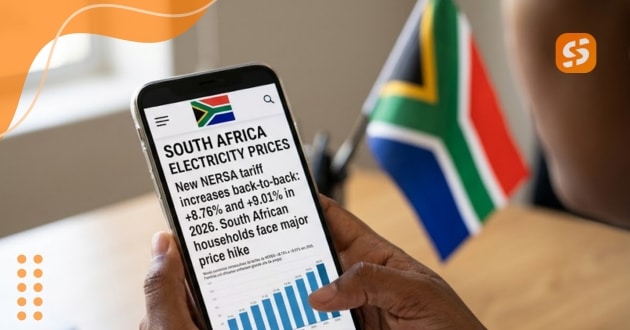
If your electricity bill keeps going up every month, you have already noticed the real impact of South Africa electricity prices on your wallet. Even when power cuts decrease, the amount charged per kilowatt-hour continues to rise. This constant increase weighs heavier and heavier on the household budget.
Today, we analyze the rules that set South Africa electricity prices. We uncover the fixed charges on your bill. Furthermore, we show how to choose the ideal tariff plan to spend less on energy.
Understanding the calculation behind South Africa electricity prices is the first step toward not paying more than you should. Therefore, read on to discover where the hidden costs are. That way, you can protect your money today.
What Determines Electricity Prices in South Africa?

Many consumers think that electricity is charged in a simple way, measuring only what the meter records at the end of the month.
However, the South African tariff system involves complex regulatory rules. It includes financial targets from the state utility Eskom. It also depends on decisions by NERSA (National Energy Regulator of South Africa).
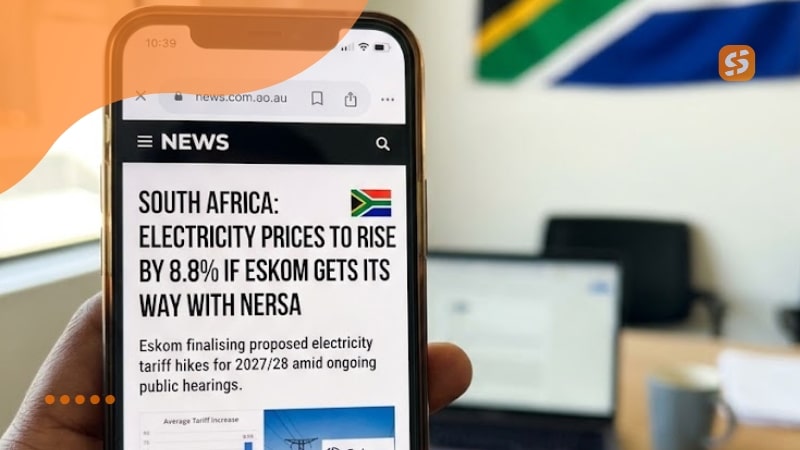
NERSA evaluates periodic revenue applications from Eskom.
The utility needs to cover costs for fuel, power station maintenance, and accumulated debt servicing. Because of this, it requests periodic adjustments. These increases end up being passed on directly to the bills of families and businesses.
In addition, the way electricity reaches your property completely changes the final price:
- Direct Eskom customers: pay nationally approved tariffs, split between consumption costs and fixed connection charges.
- Municipality-supplied customers: buy energy that the local municipality purchased in bulk from Eskom. Each municipality adds a profit margin to fund local public services. This factor usually makes urban tariffs more expensive.
This dual model explains why two homes with the same consumption pattern can pay very different amounts depending on the neighborhood or city in which they are located.
How Do the Main Residential Tariff Options Work?
To understand your bill, you need to identify which supply category your home is classified under.
Eskom divides residential consumers into three main categories, each with a distinct billing structure.
1. Homelight (South Africa electricity prices)
The Homelight category serves most urban and suburban homes through prepaid meters.
In this option, the user buys units before consuming and does not receive monthly bills with fixed charges.
There are two main tiers within Homelight:
- Homelight 20A: aimed at low-consumption households, supported by social subsidies and reduced rate per energy unit.
- Homelight 60A: aimed at standard consumption, with a linear charge per kilowatt-hour (kWh) consumed, without time-of-use rate variations.
The advantage of Homelight is daily budget control.
Since there are no built-in daily network fees, you only pay for the exact volume you decide to load into the meter.
2. Homepower
Homepower is the standard plan for conventional postpaid 60 to 80 amp connections.
Unlike prepaid, this category combines two types of charges: actual energy consumption and daily fixed fees.
Among the fixed charges billed every month, key items include:
- Network capacity charge: covers physical maintenance of power lines, poles, and transformers supplying the property.
- Service and administration charges: cover billing emission expenses, customer care, and operational support.
- Generation capacity charge (GCC): ensures a fixed contribution toward keeping power plants ready to operate during peak demand times.
Due to these fixed portions, even if the home stays vacant the entire month, the bill will arrive with a minimum required payment.
3. Homeflex (South Africa electricity prices)
Homeflex uses the Time-of-Use (TOU) system.
Instead of a single rate all day long, the kilowatt-hour cost varies according to the time of day and season of the year.
During winter months (June to August), morning and evening peak hours can cost up to six times more than off-peak hours.
Conversely, late nights and sunny summer afternoons see a substantial decrease in unit costs.
This plan benefits those who own smart appliances, home batteries, or have flexible routines. However, it can drive up bills for those using showers and heaters in the early evening.
The Burden of Fixed Costs and Its Impact on Low-Consumption Families
In recent tariff cycles, the regulator unbundled costs to increase bill transparency. However, the practical effect penalized households using less electricity.
Prior to this shift, network operational costs were bundled into the rate of each kilowatt-hour.
With daily fixed charges on the Homepower plan, a household consuming 350 kWh per month feels a proportionally larger impact on total costs compared to a property consuming 1,500 kWh.
Consider the following example:
- A house consuming 350 kWh per month pays around R536 in fixed fees alone before using any power. This fixed fee represents over 30% of the final bill amount.
- A neighboring house consuming 1,500 kWh monthly pays the exact same R536 fixed fee. For this family, the fixed fee represents less than 10% of their total bill.
This mathematical distortion means saving kilowatt-hours does not always result in expected monetary savings. As a result, this creates frustration for thousands of consumers.
Are Solar Panels the Solution to High Electricity Costs?
With constantly rising tariffs, thousands of residents have invested in rooftop solar generators (SSEG) to produce their own electricity.
Solar generation reduces power purchases from the grid, but the formal registration process brings costs many are unaware of.
When legally registering solar panels with the utility, the property loses eligibility for the prepaid Homelight tariff. The utility requires mandatory migration to the postpaid Homeflex plan.
This technical shift involves immediate financial requirements:
- Bidirectional meter installation: requirement for approved meters that record both consumption and grid feed-in. These devices cost thousands of rands.
- Contractual security deposit: requirement for a security deposit equivalent to up to three months of average consumption at current energy rates.
- Permanent fixed charges: loss of exemption from daily fees. This forces residents to pay network availability tariffs even when generating all their power during the day.
For middle-class urban homes, these additional expenses can range between R10,000 and R20,000 just for initial bureaucracy.
On rural or agricultural properties, required deposits can exceed R100,000.
Therefore, calculating the payback period for solar investments must account for these charges.
Conclusion
South Africa’s energy landscape shifted from a physical generation shortage crisis to a tariff management and financial sustainability crisis.
Even if power supply remains stable, pressures on South Africa electricity prices are expected to persist over coming regulatory cycles.
To safeguard your personal finances or business costs, the most effective approach is taking control of your consumption data.
Identify which tariff your meter is registered on, understand the weight of fixed monthly fees, and eliminate waste in high thermal load equipment.
Stay informed on regulatory decisions and evaluate every alternative investment with actual data. This ensures you make the best choices for your budget, spending only what is necessary on the energy you consume.
Another issue impacting power prices directly is the water crisis. Therefore, check out everything about the South Africa water crisis 2026 and understand how it affects your life.